
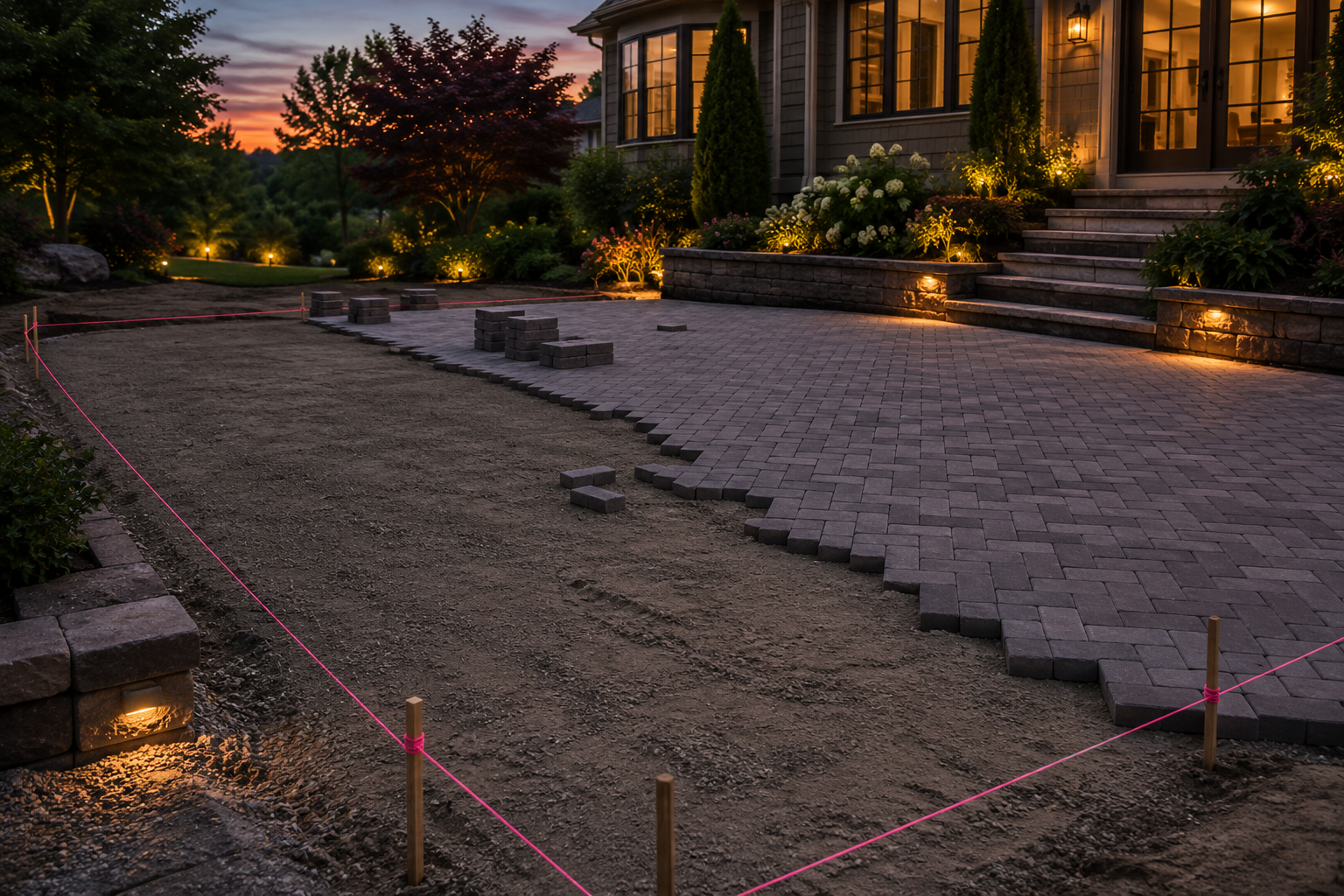
While many contractors focus on square footage, profitable estimating requires a much deeper evaluation of the project. Site access, excavation requirements, drainage conditions, material quantities, labor production rates, and gross profit margins all play a role in determining the final selling price.
Successful contractors don't simply calculate the materials. They estimate the entire project from planning through installation.
Initial Planning Phase
Before calculating labor or materials, evaluate the project site.
A patio located beside a driveway may require significantly less labor than a patio located behind a house with limited access.
Consider Site Access
Ask yourself:
Is the patio in the front yard or backyard?
Must materials be wheelbarrowed long distances?
Is the site uphill or downhill?
Are there gates, fences, or narrow access points?
Can equipment reach the work area?
Every obstacle increases labor requirements.
Material Staging
Material placement directly affects production.
Consider:
Gravel delivery location
Sand delivery location
Paver staging location
Spoil removal
The farther materials must travel, the higher the labor cost.
Existing Conditions
Evaluate:
Irrigation systems
Tree roots
Utilities
Existing concrete
Existing patios
Drainage issues
Unexpected conditions can dramatically impact labor production and profitability.
Site Preparation
Site preparation is often the most labor-intensive phase of the project.
Excavation
Excavation requirements depend on:
Patio size
Paver brick size & patio base depth
Soil conditions
Drainage requirements
Labor estimates should include:
Excavation labor
Equipment costs
Hauling
Dump fees
Using Your Company's Excavation Production Rate
Most contractors already know approximately how many square feet they can excavate per hour.
For example:
If your crew can excavate:
150 square feet per hour
and the project requires:
600 square feet
then:
600 ÷ 150 = 4 labor hours
Using company production rates helps create consistent estimates.
Drainage Considerations
Proper drainage is critical to long-term performance and easiest to install during the paver installation process.
Potential additions include:
Catch basins
Drain pipe
Drain rock
Area drains
These items should be included in both labor and material calculations during your estimate.
Installation Phase
Once the site has been excavated and prepared, installation begins.
Aggregate Base
The aggregate base provides structural support.
Estimators should account for:
Material quantity
Delivery costs
Compaction
Waste factors
Bedding Sand
Include:
Sand quantity
Delivery
Labor
Waste
Pavers
Pavers are typically the largest material expense.
Material calculations should include:
Total patio area
Paver size
Waste factor
Pattern complexity
Edge Restraints
Don't forget:
Edging materials
Fasteners
Labor
These components are essential to a long-lasting installation.
Estimating Paver Installation Labor
After materials are calculated, labor must be estimated.
One simple method is to determine how long it takes your crew to install a single paver.
Example:
One paver every 30 seconds
Equals:
Two pavers per minute
120 pavers per hour
If the project contains:
1,200 pavers
Then:
1,200 ÷ 120 = 10 labor hours
This provides a baseline production estimate.
Adjustments should then be made for:
Cutting
Borders
Complex patterns
Site access
Elevation changes
Don't Forget Waste Factors
Paver projects almost always require additional material.
Waste factors help account for:
Cuts
Breakage
Pattern layouts
Future repairs
Many contractors use:
5% waste
10% waste on complex patterns
Failing to account for waste can significantly reduce profitability.
Equipment Costs
Many contractors overlook equipment expenses.
Examples include:
Excavators
Skid steers
Plate compactors
Cut-off saws
Dump trailers
Equipment costs should be included within the estimate.
Build Gross Profit Into Every Estimate
After calculating:
Labor
Materials
Equipment
Subcontractors
the estimate should be adjusted to achieve your target Gross Profit Margin (GPM).
Gross profit helps cover:
Office expenses
Insurance
Administrative staff
Equipment replacement
Marketing
Business growth
Many landscape contractors target:
35%–50% Gross Profit Margin
depending on project type and market conditions.
A profitable estimate isn't simply cost plus markup.
It's an estimate designed to achieve a target gross profit margin.
Final Thoughts
There is no universal price for installing a paver patio.
Every project is affected by:
Site access
Excavation requirements
Drainage conditions
Material quantities
Production rates
Equipment costs
Gross profit targets
The most successful contractors estimate each phase of the project independently and then combine those costs into a profitable selling price.
Understanding the relationship between planning, production, materials, labor, and gross profit allows landscape contractors to create accurate estimates while protecting profitability.
Because profitable paver projects begin with profitable estimates.
The Landscape Estimator can help you with all of these numbers and more. Check out TheLandscapeEstimator.com
Keep reading
More updates, releases, and estimating ideas are in the newsroom.