
Imagine receiving a phone call from a homeowner asking for an estimate to install a new landscape.
You schedule a visit.
Walk the property.
Take measurements.
Write down a few notes.
Discuss the customer's vision.
Then comes the question every landscape contractor eventually asks themselves.
"How much should I charge?"
For many contractors, the answer comes from experience.
Some estimate by square footage.
Others compare the project to one they completed a few months ago.
Some simply trust their instincts.
While experience is valuable, successful landscape companies understand that every estimate is much more than a price.
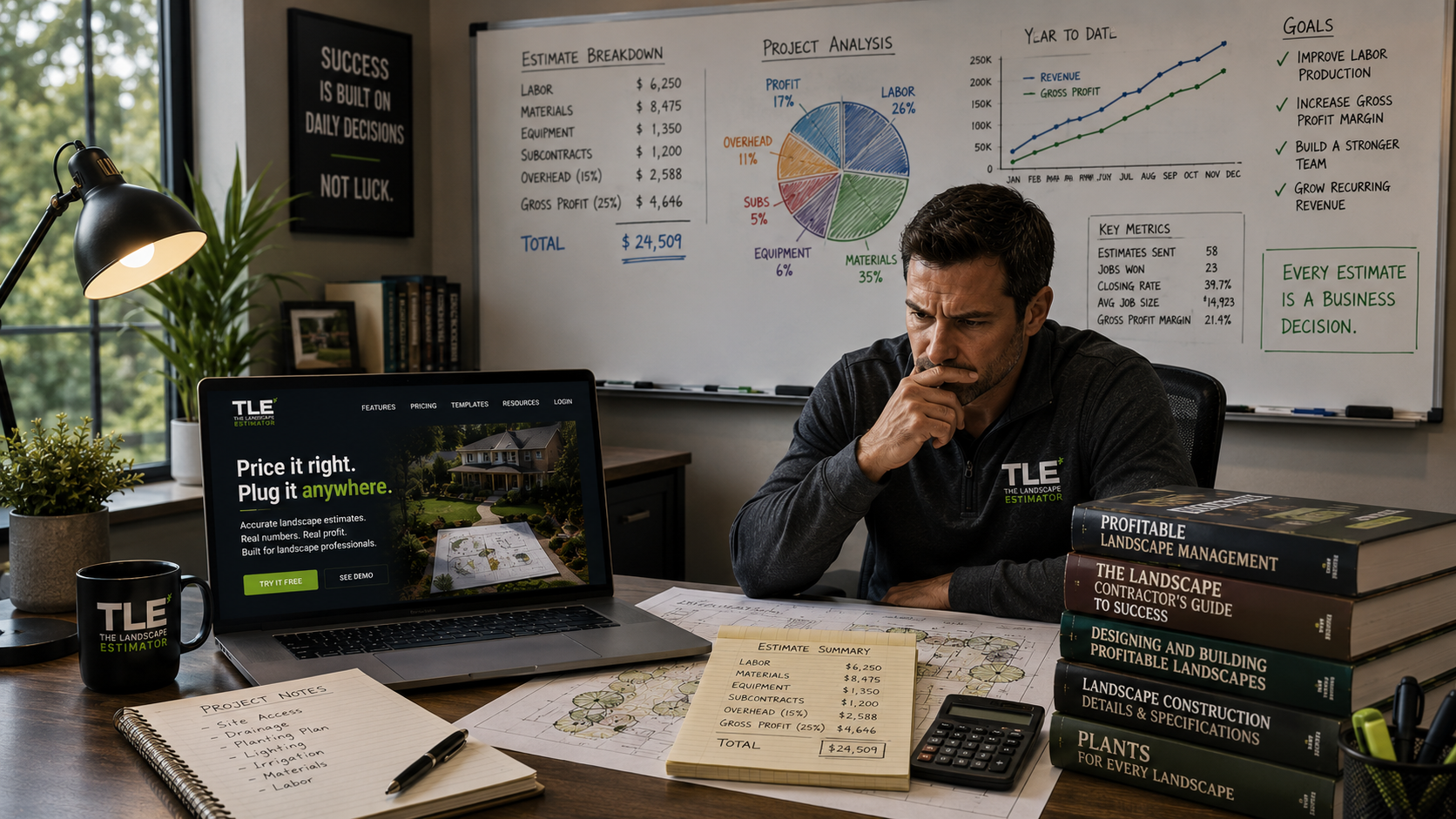
Every estimate is a business decision.
Every Estimate Shapes Your Company
When customers receive a proposal, they see a price.
When business owners look at that same proposal, they should see something much bigger.
An estimate determines:
Whether the project will be profitable.
Whether enough labor has been allocated.
Whether materials have been calculated correctly.
Whether equipment costs have been considered.
Whether the company can continue investing in its future.
Long before the project begins, the estimate has already influenced the financial outcome.
Every estimate either strengthens the company or quietly weakens it.
Guessing Isn't a Growth Strategy
Most landscape contractors begin their careers estimating from experience.
There is nothing wrong with that.
Experience is often one of your greatest assets.
The problem begins when experience becomes guessing.
A project that is underbid by only a few hundred dollars may not seem significant.
But repeat that mistake dozens of times throughout the year, and thousands of dollars disappear without anyone realizing why.
Successful companies don't eliminate experience.
They support it with systems.
Instead of asking,
"What did I charge on my last project?"
They begin asking,
"What should this project actually cost?"
That small change in thinking often becomes one of the biggest turning points in a growing business.
Every Estimate Has Four Building Blocks
Although every landscape project is different, nearly every estimate is built from the same four components.
Labor
Labor is typically the largest expense on most landscape projects.
Understanding production rates allows contractors to estimate labor based on measurable performance instead of assumptions.
Successful estimators consider:
Production rates
Crew size
Site access
Travel time
Cleanup
Project difficulty
Accurate labor estimates create consistent results.
Materials
Every project requires materials.
Whether installing:
Plants
Sod
Bark dust
Irrigation
Landscape lighting
Pavers
each material carries a cost that should be understood before the proposal is presented.
Material estimates should also consider:
Waste
Delivery
Handling
Material markup
Small material errors repeated throughout the year can significantly reduce profitability.
Equipment
Equipment is often overlooked because contractors already own it.
However, excavators, skid steers, trucks, trailers, compactors, and saws all cost money to operate.
Fuel.
Maintenance.
Repairs.
Depreciation.
Replacement.
Every project uses equipment, and every estimate should account for it.
Profit
Profit should never be treated as whatever remains after expenses.
Profit should be intentionally built into every estimate.
Healthy profits allow companies to:
Purchase equipment.
Hire employees.
Invest in training.
Improve customer service.
Continue growing.
Without profit, growth eventually comes to a stop.
Consistency Creates Confidence
Imagine two estimators pricing the exact same landscape project.
Without standards, both estimates may differ by thousands of dollars.
That isn't simply an estimating problem.
It's a business problem.
Successful companies develop repeatable estimating systems.
They standardize:
Production rates
Material calculations
Waste factors
Proposal formats
Pricing methods
Consistency produces confidence.
Confidence creates professionalism.
Professionalism builds trust.
Your Estimate Is Often the First Impression
Customers begin judging your company long before the first day of construction.
A professional estimate demonstrates:
Organization
Preparation
Experience
Attention to detail
A clear proposal tells customers they are working with a professional company that has invested time into understanding their project.
In many cases, the estimate becomes your first opportunity to earn their trust.
Think Beyond Today's Project
Every estimate should answer one important question.
"Will this project help strengthen my company?"
Some projects create excellent profits.
Some lead to long-term maintenance contracts.
Some generate referrals that produce future work.
Others help establish relationships within a neighborhood or commercial property.
Successful contractors understand that every estimate has value beyond today's revenue.
Final Thoughts
Successful landscape companies don't simply sell projects.
They make business decisions.
Every estimate determines how labor, materials, equipment, and profit come together to create a successful project.
When estimating becomes a repeatable business process instead of a guessing game, contractors gain something much more valuable than accurate pricing.
They gain confidence.
They gain consistency.
And consistency is one of the strongest competitive advantages a landscape company can have.
Because every successful company is still built...
One Estimate at a Time.
Business Takeaway
An estimate isn't simply a price presented to a customer.
It's one of the most important business decisions you'll make.
The better your estimating process becomes, the stronger your company becomes.
TLE Tip
Successful estimating begins with consistency. The Landscape Estimator (TLE) helps contractors build repeatable estimating systems by guiding users through labor, materials, production rates, and proposal generation—allowing every estimate to be customized while maintaining consistent business practices.
Coming Next
Part 3: Building Your First Profitable Estimate
In the next article, we'll build a complete landscape estimate from start to finish while discussing labor, materials, equipment, waste factors, gross profit, and how successful contractors intentionally build profitability into every project before the work even begins.
Keep reading
More updates, releases, and estimating ideas are in the newsroom.