

Every landscape contractor remembers writing their first estimate.
Maybe it was for a neighbor.
A family member.
Or perhaps it was the first customer who trusted you enough to ask for a proposal.
Most contractors remember one thing very clearly.
They were nervous about the price.
Charge too much, and you might lose the job.
Charge too little, and you may win the project—but lose money.
That challenge never completely disappears.
The difference is that successful landscape companies eventually stop guessing and begin building estimates with purpose.
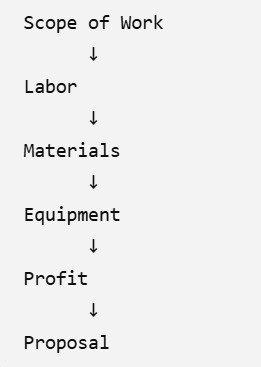
Every profitable estimate follows the same basic process.
Start With the Scope of Work
Before discussing labor or materials, define exactly what the customer expects.
A vague proposal often creates expensive misunderstandings.
Ask yourself:
What work is included?
What materials will be installed?
What is specifically excluded?
What assumptions am I making?
The more clearly the project is defined, the easier it becomes to estimate accurately.
A good estimate begins with understanding the work—not calculating the price.
Labor Comes Before Dollars
One of the most common estimating mistakes is assigning a dollar amount before determining the labor required.
Instead, begin by asking:
"How long will this project actually take?"
Think about every phase of the project.
Site preparation
Material delivery
Installation
Cleanup
Travel time
As your company grows, you'll begin developing production rates for common tasks.
Those production rates become one of the most valuable tools in your business because they replace guessing with measurable performance.
Labor creates the foundation of every estimate.
Calculate Materials Carefully
Once labor has been considered, determine the materials needed to complete the project.
Estimate:
Quantities
Delivery
Waste
Material markup
Whether you're installing plants, pavers, irrigation, bark dust, or landscape lighting, every material should be calculated rather than approximated.
Remember that small material mistakes repeated throughout the year can quietly reduce profitability.
Don't Forget Equipment
Many contractors remember labor and materials but overlook equipment.
Ask yourself:
Will this project require an excavator?
A skid steer?
A plate compactor?
A dump trailer?
Specialty tools?
Even if you already own the equipment, every hour it operates contributes to fuel, maintenance, repairs, and eventual replacement.
Equipment is part of the cost of doing business.
Build Profit Into the Estimate
This is where many contractors unintentionally make their biggest mistake.
After calculating labor, materials, and equipment, some simply total the costs and hope enough money remains.
Successful companies take a different approach.
They intentionally build profit into every estimate.
Profit isn't extra.
Profit allows your company to:
Replace equipment.
Hire employees.
Invest in training.
Improve customer service.
Continue growing.
Without profit, there is no long-term business.
Every Estimate Is a Learning Opportunity
No estimate will ever be perfect.
Even experienced contractors continue improving.
After each completed project, compare your estimate to the actual results.
Ask questions such as:
Did labor take longer than expected?
Were material quantities accurate?
Was enough time allowed for travel and cleanup?
Did we achieve our desired gross profit?
Every completed project makes the next estimate more accurate.
That continuous improvement is what separates successful companies from those that continue guessing.
The Goal Isn't Winning Every Bid
One of the hardest lessons for new contractors is realizing that not every project should be won.
Winning work by underpricing your services may keep crews busy, but it rarely builds a healthy business.
Successful companies understand that a profitable estimate is more valuable than an accepted estimate that loses money.
The goal isn't to win every customer.
The goal is to build a profitable company.
Final Thoughts
A profitable estimate isn't created by chance.
It's built one decision at a time.
First, understand the work.
Then calculate the labor.
Determine the materials.
Account for equipment.
Finally, build profit into the estimate before presenting it to the customer.
The process may seem simple.
The discipline to repeat it consistently is what separates successful landscape companies from the rest.
Because profitable businesses aren't built by guessing.
They're built...
Business Takeaway
Every profitable estimate follows a repeatable process.
When labor, materials, equipment, and profit are considered before the proposal is presented, your estimates become more consistent—and your business becomes more profitable.
TLE Tip
One of the biggest advantages of using The Landscape Estimator (TLE) is creating consistency throughout your estimating process. By guiding contractors through labor, materials, production rates, and project variables, TLE helps ensure every estimate follows the same proven framework while still allowing adjustments for each project's unique conditions.
Coming Next
Part 4: Small Profits Become Big Companies
We'll demonstrate how one profitable estimate, repeated consistently over weeks, months, and years, becomes the foundation of a million-dollar landscape business.
Keep reading
More updates, releases, and estimating ideas are in the newsroom.