
One of the most common questions landscapers ask is, "How much should I charge for landscape maintenance?" Unfortunately, there is no one-size-fits-all answer. Charging too little can leave you struggling to make a profit, while charging too much may cost you potential customers.
The good news is that landscape maintenance estimates can be built using the same process as many other landscape services. The goal is to accurately estimate labor requirements, determine material quantities, and build a consistent production-based estimate.
Step 1: Gather Property Information
Before building an estimate, you need a clear understanding of the property.
During your site visit, gather information such as:
Total turf area
Flower bed square footage
Parking lot size
Sidewalk and hardscape areas
Number of trees
Number of shrubs
Irrigation system type
Site accessibility
Property condition
The more accurate your measurements, the more accurate your estimate will be.
Step 2: Determine the Type of Maintenance Program
Not all maintenance contracts are structured the same way.
Ask yourself:
Is this a residential property?
Is this a commercial property?
Is the customer requesting full-service maintenance?
Is mowing only required?
Will seasonal services be included?
A full-service maintenance agreement may include:
Mowing
Edging
Blowing
Bed maintenance
Weeding
Pruning
Irrigation inspections
Fertilization
Leaf cleanup
Seasonal color
Bark dust replacement
Clearly defining the scope of work prevents misunderstandings and helps ensure all services are included in your estimate.
Residential vs. Commercial Maintenance
One of the first decisions you should make when estimating landscape maintenance is determining whether the property will be maintained as a residential or commercial account. While many of the services may be similar, the expectations, service frequencies, and labor requirements can vary significantly.
Residential Properties
Residential clients are often focused on curb appeal and the overall appearance of their landscape. They may request additional services such as detailed pruning, flower bed maintenance, seasonal color changes, irrigation monitoring, and specialty care for high-value plants.
When estimating residential maintenance, pay close attention to:
Property appearance expectations
Detail pruning requirements
Seasonal cleanup needs
Specialty plant material
Irrigation monitoring
Customer communication requirements
Residential properties frequently require a higher level of detail, which can increase labor time even on smaller sites.
Commercial Properties
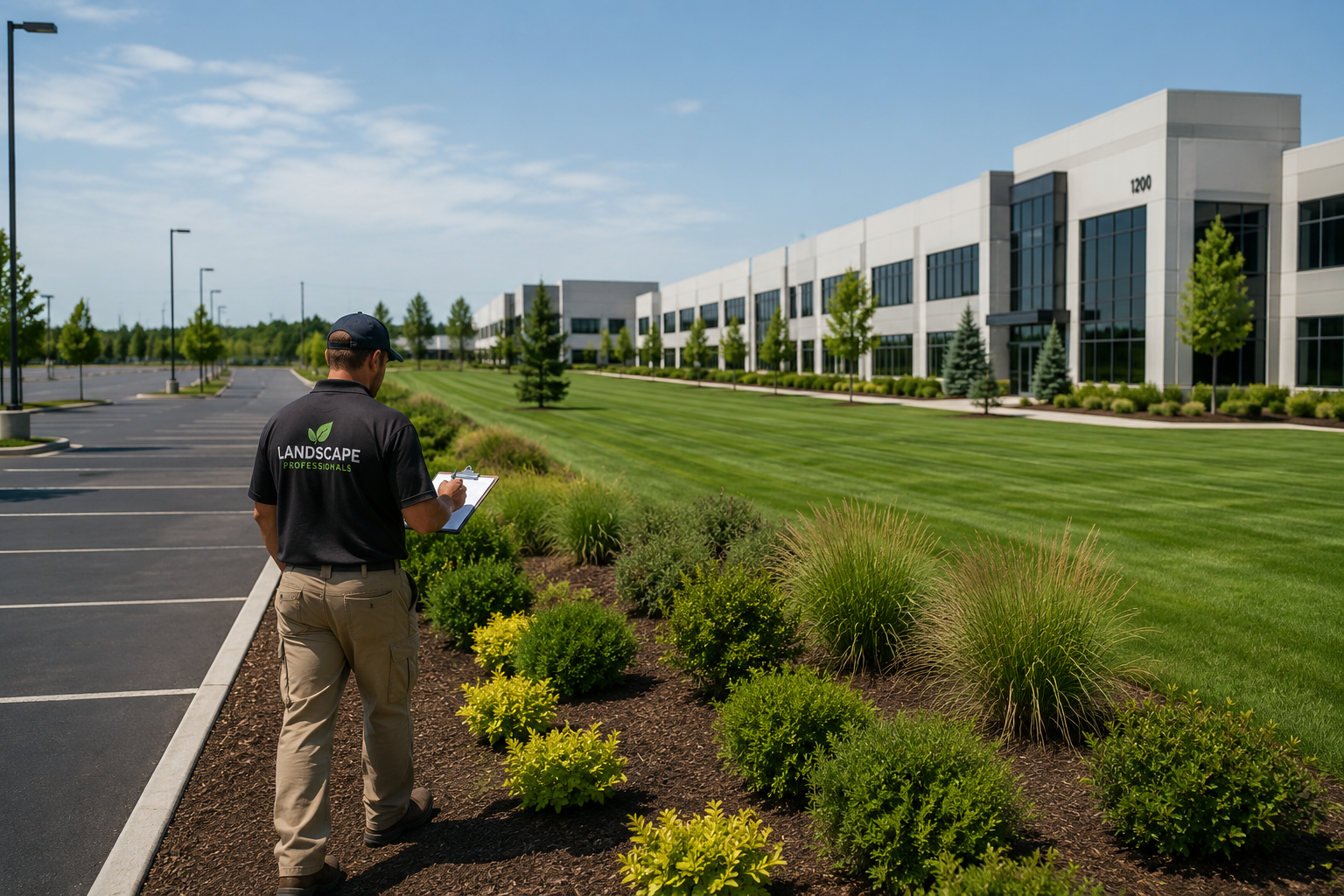
Commercial maintenance is often focused on consistency, safety, and maintaining a professional appearance. These properties may include office buildings, retail centers, apartment communities, industrial facilities, homeowner associations, healthcare campuses, and other commercial sites.
When estimating commercial maintenance, evaluate:
Turf square footage
Landscape bed square footage
Parking lot and sidewalk areas
Tree and shrub counts
Irrigation system size
Debris removal requirements
Site accessibility
Service hour restrictions
Commercial properties may require additional services such as parking lot blowing, litter pickup, seasonal inspections, and documentation of completed work.
Because commercial properties are often larger and serviced on a recurring schedule, accurate production rates become especially important when building the estimate.
Regardless of property type, the estimating process remains the same: gather accurate measurements, define the scope of work, estimate labor using production rates, and account for any materials required to maintain the property throughout the year.
Step 3: Estimate Turf Maintenance
For many properties, turf maintenance represents the largest portion of recurring service.
Measure the total turf area and determine:
Mowing frequency
Edging requirements
Trimming requirements
Blowing requirements
Using your company's production rates, estimate how much time your crew will require to complete these tasks during each visit.
Step 4: Estimate Bed Maintenance
Next, evaluate all landscape beds.
Measure the total bed square footage and determine:
Weeding requirements
Shrub pruning requirements
Groundcover maintenance
Debris removal requirements
Seasonal cleanup requirements
Some properties may require monthly bed maintenance while others require attention during every visit.
Step 5: Evaluate Trees and Shrubs
Count all trees and shrubs on the property.
Consider:
Pruning frequency
Shearing requirements
Seasonal cleanup needs
Debris generation
A property with twenty shrubs requires a much different maintenance effort than a property with two hundred shrubs.
Step 6: Review Irrigation Requirements
The irrigation system often plays an important role in landscape maintenance.
Determine whether the estimate should include:
Spring startup
Seasonal adjustments
System inspections
Head replacements
Winterization
Some contractors include these services in the maintenance agreement, while others price them separately.
Step 7: Identify Additional Services
Many landscape maintenance contracts include services beyond routine visits.
Examples include:
Leaf cleanup
Bark dust installation
Seasonal flower rotations
Pressure washing
Parking lot sweeping
Storm cleanup
Determine whether these services will be included in the contract or billed separately.
Step 8: Determine Service Frequency
Once the scope of work has been established, determine how many times each service will be performed throughout the year.
A typical full-service maintenance program may include:
Mowing – 38 visits
Edging – 38 visits (alternating hard / soft edges)
Blowing Hard Surfaces – 38 visits
Bed Weeding – 38 visits
Fertilization – 4 visits
Shrub Pruning – 1 annual pruning service
Leaf Cleanup – 8 visits
Remaining Visits – 12 visits (commercial properties only)
Irrigation Startup – 1 visit
Irrigation Adjustments – 2 visits
Winterization – 1 visit
The exact service frequencies will vary depending on your region, climate, property type, and customer expectations. The goal is to identify every service that will be performed during the year before estimating labor and materials.
By creating a complete annual service schedule, you can ensure that no services are overlooked and that each task is properly accounted for in the estimate.
Step 9: Estimate Labor for Each Service
Once service frequencies have been established, calculate the labor required for each service individually.
For example:
Calculate mowing labor using your production rates.
Calculate edging labor using your production rates.
Calculate bed maintenance labor using your production rates.
Calculate pruning labor using your production rates.
Calculate irrigation service labor using your production rates.
Rather than estimating the property as a whole, estimate each service separately. This approach helps identify exactly where labor is being spent and creates a more accurate maintenance estimate.
Step 10: Estimate Materials
Some maintenance services require materials throughout the year.
Examples include:
Fertilizer
Bark dust
Seasonal flowers
Irrigation parts
Herbicides
Plant replacements
Determine the quantities required for each service and apply your standard material markup.
Step 11: Build Your Annual Maintenance Estimate
Once labor and materials have been calculated for each service, combine them into a single annual maintenance estimate.
Many landscapers find it helpful to build the estimate as an annual total first and then divide it into monthly payments for the customer. This helps ensure that seasonal services such as leaf cleanup, bark dust, irrigation services, and other periodic maintenance items are fully accounted for throughout the year.
Final Thoughts
Landscape maintenance estimating starts with gathering accurate site information and clearly defining the scope of work. By measuring the property, identifying required services, determining annual service frequencies, estimating labor using production rates, and accounting for materials, landscapers can build consistent and repeatable maintenance estimates.
The more structured your estimating process becomes, the easier it is to create accurate proposals, maintain profitability, and deliver consistent results for your customers.
The Landscape Estimator can perform these estimates in seconds versus minutes. Check out our estimate for general landscape maintenance for more information.
Keep reading
More updates, releases, and estimating ideas are in the newsroom.