
One of the most common questions landscapers ask is:
"How many labor hours should this job take?"
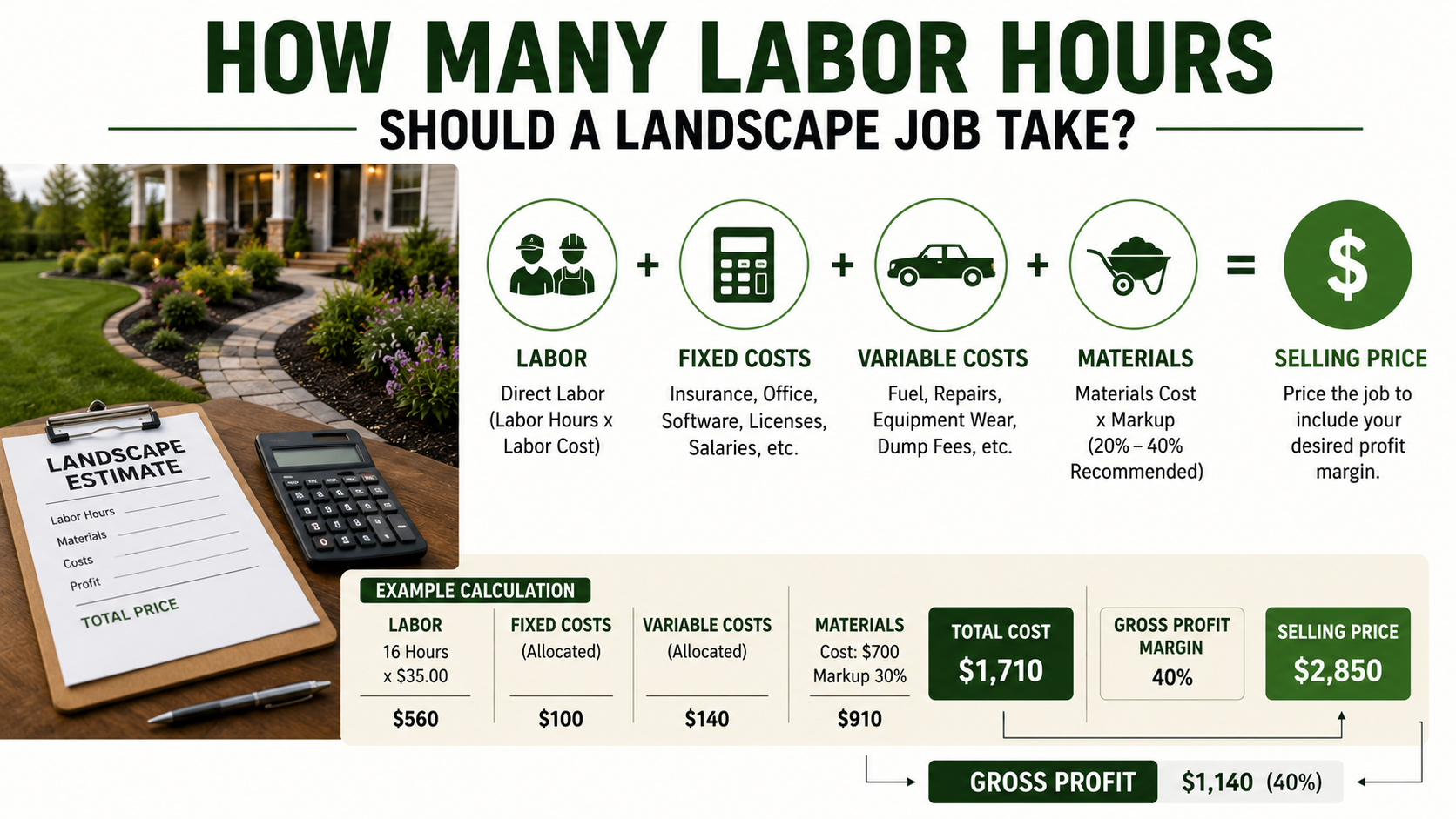
While labor production rates are important, simply knowing how long a job takes is not enough. To build a profitable landscaping business, you must understand the true cost of labor and how that labor impacts your final selling price.
Many landscapers make the mistake of calculating labor based solely on employee wages. Unfortunately, this often leads to underbidding projects, shrinking profit margins, and cash flow problems.
In this guide, we'll explain how to estimate labor hours, account for direct and indirect costs, mark up materials properly, and calculate a profitable selling price.
Step 1: Estimate the Labor Hours
The first step is determining how many hours the project will require.
For example, let's assume a bark dust installation project requires:
Crew Size: 2 employees
Estimated Time: 8 hours
Total Labor Hours:
2 Employees × 8 Hours = 16 Labor Hours
The question now becomes:
What is your actual labor cost per hour?
Step 2: Calculate Your True Labor Cost
Many landscapers only consider hourly wages.
Example:
Employee Wage: $25.00/hour
However, your company also pays:
Payroll taxes
Workers compensation insurance
Unemployment insurance
Paid downtime
Training time
Vehicle expenses
Supervision
A common rule of thumb is that a $25/hour employee may actually cost the company $35/hour or more. You can use a percentage markup for estimating labor in the begining for simplicity (Example: actual labor costs x 1.4 <-- This will increase your actual labor costs from $20 to $20 x 1.4 = $28 / hour)
Example:
16 Labor Hours × $35/hour = $560 Labor Cost
Step 3: Add Fixed and Variable Costs
Every landscape project contributes toward business expenses.
Fixed Costs
Fixed costs generally stay the same regardless of workload:
Office rent
Insurance
Software
Phones
Licensing
Administrative staff
Variable Costs
Variable costs increase as work increases:
Fuel
Equipment wear
Dump fees
Repairs
Delivery charges
Consumable supplies
For this example, let's allocate:
Fixed Cost Allocation = $100
Variable Cost Allocation = $140
Total Operating Costs:
$100 + $140 = $240
Step 4: Calculate Material Costs
Let's assume the project requires:
Bark Dust = $600
Delivery = $100
Total Material Cost:
$700
Step 5: Mark Up Materials
Most landscaping companies mark up materials to cover purchasing time, warranty risk, handling, and profit.
A common recommendation is:
Minimum Markup: 20%
Typical Markup: 25%–40%
Using a 30% markup:
$700 × 30% = $210
Selling Price of Materials:
$910
Step 6: Calculate Total Job Cost
Labor Cost = $560
Operating Costs = $240
Material Cost = $700
Total Job Cost:
$1,500
Step 7: Add Profit Margin
Many landscapers mistakenly add a small markup and hope there is profit remaining.
Instead, profit should be intentionally built into every estimate.
Let's target a 40% Gross Profit Margin.
To determine the selling price:
Selling Price = Total Cost ÷ (1 − Gross Margin)
Selling Price = $1,500 ÷ 0.60
Selling Price = $2,500
Job Summary
Labor:
$560
Fixed & Variable Costs:
$240
Materials:
$700
Total Cost:
$1,500
Selling Price:
$2,500
Gross Profit:
$1,000
Gross Profit Margin:
40%
Why Many Landscapers Underbid Jobs
Most underpriced landscape estimates happen because contractors forget one or more of the following:
Payroll burden
Workers compensation
Equipment costs
Fuel
Administrative expenses
Material markup
Desired profit margin
The result is a project that appears profitable on paper but produces little profit once completed.
The Goal Is Not the Lowest Price
Many contractors believe winning more jobs requires being the cheapest bidder.
Successful landscaping companies understand that profitability comes from accurate estimating, not low pricing.
A properly priced estimate allows your company to:
Pay employees competitively
Replace equipment
Invest in growth
Maintain healthy cash flow
Deliver quality service
Final Thoughts
Determining how many labor hours a landscape job should take is only the beginning. To create profitable estimates, landscapers must understand their true labor costs, allocate overhead expenses, mark up materials appropriately, and build profit into every project.
The most successful landscape companies don't guess. They use systems and processes to ensure every estimate contributes to the long-term success of the business.
Because a profitable landscape company starts with a profitable estimate.
The Landscape Estimator can help you with your pricing and estimates!
Keep reading
More updates, releases, and estimating ideas are in the newsroom.